Fifty or so years after I first learned of the Pacific Electric and models of its cars and structures, I’m embarking on my next small layout project, the Pacific Electric Express Yard.
My journey to the Express Yard—so far—has been a fun exercise in figuring out the mix between exciting individual models and subjects, on one hand, and how to successfully orchestrate those elements into a practical model railway project that fits my priorities and lifestyle.
Successful model railroads balance competing or complementary factors: artistry vs. engineering, for example, or time vs. space vs. funds. My own formulation is ‘passion vs. practicality’. For example, a railroad like the Piedmont and Northern—think big electric interurbans in Appalachian coal country—is interesting and exciting, and certainly ticks the ‘passion’ box (for me, anyway).
However, few P&N models, ready-to-run or otherwise, have ever been manufactured in any scale, so modeling the P&N would necessitate a serious commitment to researching the prototype and building individual railroad models, either from scratch or maybe kitbashing. A large Virginian and Ohio- or Allegheny Midland-style layout depicting the P&N with multiple powered locomotives and cars would likely not be practical. However, a small layout showcasing a collection of lovingly crafted P&N cars and locomotives might strike the balance between passion and practicality.
On the passion: my electric railroad interest began in earliest childhood. When I was four or five years old, I actually ‘drove the train’—orange Pullman-built interurban coaches—from somewhere in the Dunes of northwest Indiana to Michigan City on the South Shore. A few years later, I swooned over the sight of Märklin HO and Z trains running with pantographs under catenary at a department store Christmas layout in Chicago. The fascination with overhead wire is still here, 50 or so years later.
It didn’t take long for this library-loving kid to discover that for a few decades in the early 20th century, America had been criss-crossed with electric railroads, trolleys and interurbans that followed along the pathways of power lines. My native Chicagoland and Midwest had Insull’s network—my familiar South Shore, and its abandoned sister operations, the North Shore, and Chicago, Aurora, and Elgin. Similarly, Southern California had the Pacific Electric, a sprawling electric network that shaped the development of the modern LA region before the time of widespread automobile ownership.
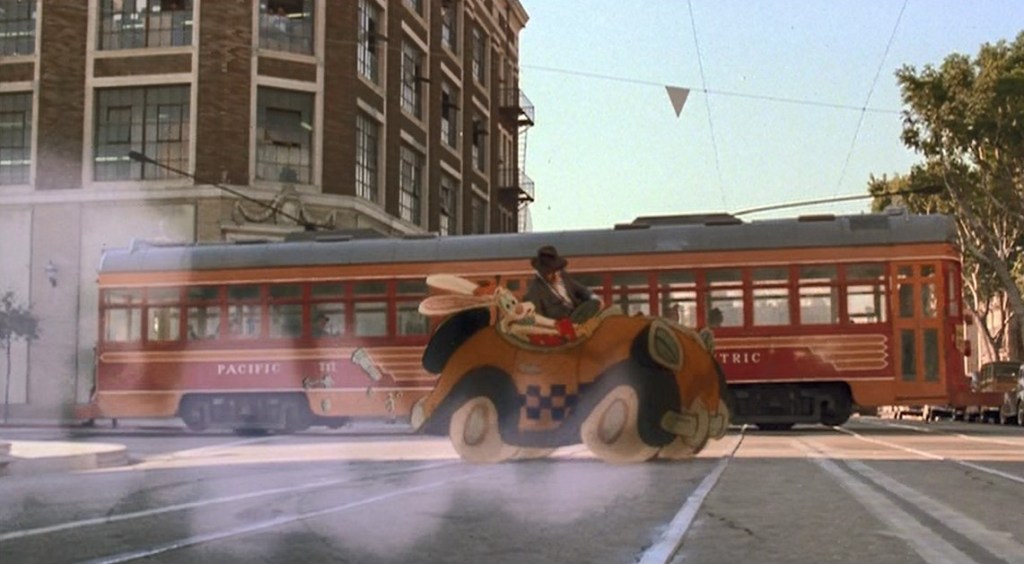
The PE was gone by the early 60s—an ‘alternate universe’ version of PE’s demise was a plot point in the 1988 Robert Zemickis film Who Framed Roger Rabbit. However, the PE at its peak was a kind of ‘standard interurban of the world’ with its distinctive red cars and variety of operations across a vast network—freight, express package, passenger, street operations, even dedicated high-speed (for the time) right-of-way.
The final decades of the PE coincided with the mid-century rise of railfanning and model railroading, and the PE did not escape the notice of rail authors, photographers, preservationists, or model railroaders. The PE bibliography compares to that of say, the Pennsylvania Railroad or the Rio Grande. And in the dog days of COVID lockdown, acquiring much of that bibliography via second-hand online booksellers was cheap, rewarding fun.
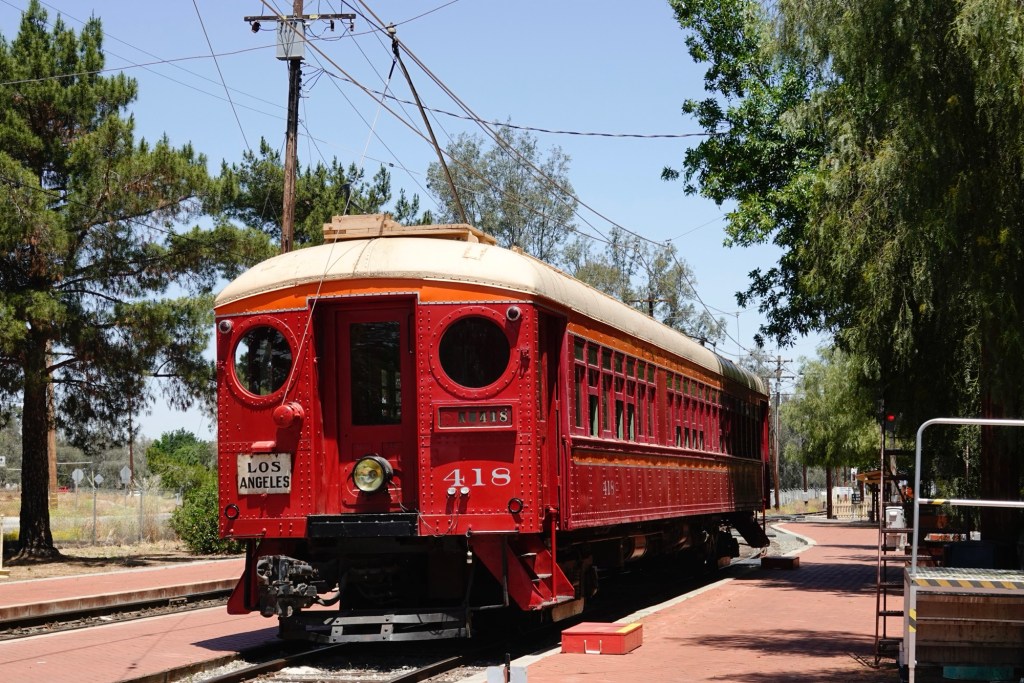
Among traction model railroaders, the PE became a staple subject. PE’s large and diverse roster has been particularly well represented in HO scale. Suydam, an early model railroad manufacturer, was among the pioneer importers of brass HO railroad models from Japan in the 1950s and 60s. PE rolling stock was a particular focus of the Suydam catalog, with most PE car types offered as brass HO models at one point or another. Second- or third-hand Suydam PE cars are currently among the least expensive and easily obtainable brass train models. Acquiring a few Suydam PE cars from online sellers during the COVID lockdown was as much fun as used PE books—but certainly not as cheap!
At an initial glance, the PE appears to check a number of boxes for fulfilling—and practical—model railroading. PE is an interesting, well-documented, and model-able prototype with layout-friendly operations (single car trains, or at most a few cars per train, on short radius curves). And PE models are (more or less) available.
Availability of suitable models is but one element of railroad modeling practicality. Personal inclinations and available resources like space and funds also have big parts to play.
In my specific case, age and associated orneriness has diminished my appetite for the typical room- or basement-sized ‘lifetime layout’, so often presented as the ideal in leading North American model railroad magazines.
At first I attributed this loss of interest to burnout after a year of marathon layout building to document and photograph my N scale ‘Old Line Corridor’ layout, which was featured in the May 2021 Railroad Model Craftsman.
However, I also realized that the OLC competed directly with my other interests, modeling and otherwise. Even the modestly-sized OLC layout project, and the required, continuous focus on a single modeling theme had been sapping my eclectic modeling mojo.
My modeling interests extend beyond model trains to include tanks, planes, spaceships, cars, trucks, giant fighting robots, and anything else that piques my interest, and any new model railroad project would necessarily need to fit with my other modeling interests.
Additionally, maintaining my other family, art, and social interests is a high priority. I like my spouse and sons, and my friends and neighbors, books, music, prestige TV, stir fry experiments, and my wider creative community. Making sure there’s room for all my sources of joy means that smaller, more modest modeling projects are the best fit into my life. Switching between and among modeling subjects of varying complexity and skill emphasis are much more fulfilling and psychologically sustainable for my temperament and interests. Even though I can afford the time, space, and funds required for a large layout—and I certainly admire large layouts—I have come to realize that I’m not inclined to focus my modeling energy on one such single, totalizing project.
As a result of this self-wisdom, I’ve become more attuned to ‘alternative’ approaches to model railroading. I’ve opened my receptiveness to new possibilities for smaller-sized layouts and modeling projects. The late Iain Rice’s ‘cameo layout’ and shelf concepts, for example, show a way to engage multiple, disparate, and manageable rail modeling interests. Lance Mindheim has parlayed knowledge gained from his model railroad layout building business into practical advice to build smaller but arguably denser and higher quality layouts.
With some of these new model railroading philosophies in mind, I would no longer need to hew to one single scale or modeling theme on a large, traditional layout to be a serious model railroader. I looked to how alternate approaches to model railroading can actually work.
At the same time, my friend Trevor Marshall stoked my enthusiasm for a new, cameo-style model railroad project. Trevor has been living the dream of multiple, achievable layouts in different scales and radically varying prototypes. Like me, Trevor has an eclectic range of model railway interests, including various modeling scales, traction, and foreign railway prototypes. Following a house move and the dismantling of his well-documented S scale Port Rowan layout, Trevor has since launched a new S scale traction layout and a UK-prototype 7mm (British O scale) Edwardian-era layout, while also engaging in non-model railroading side projects and jigsaw puzzles.
Meanwhile, Trevor provided not only inspiration and encouragement, but also a blueprint—or at least a model railway magazine article—for indulging my Pacific Electric passion on a modest scale.
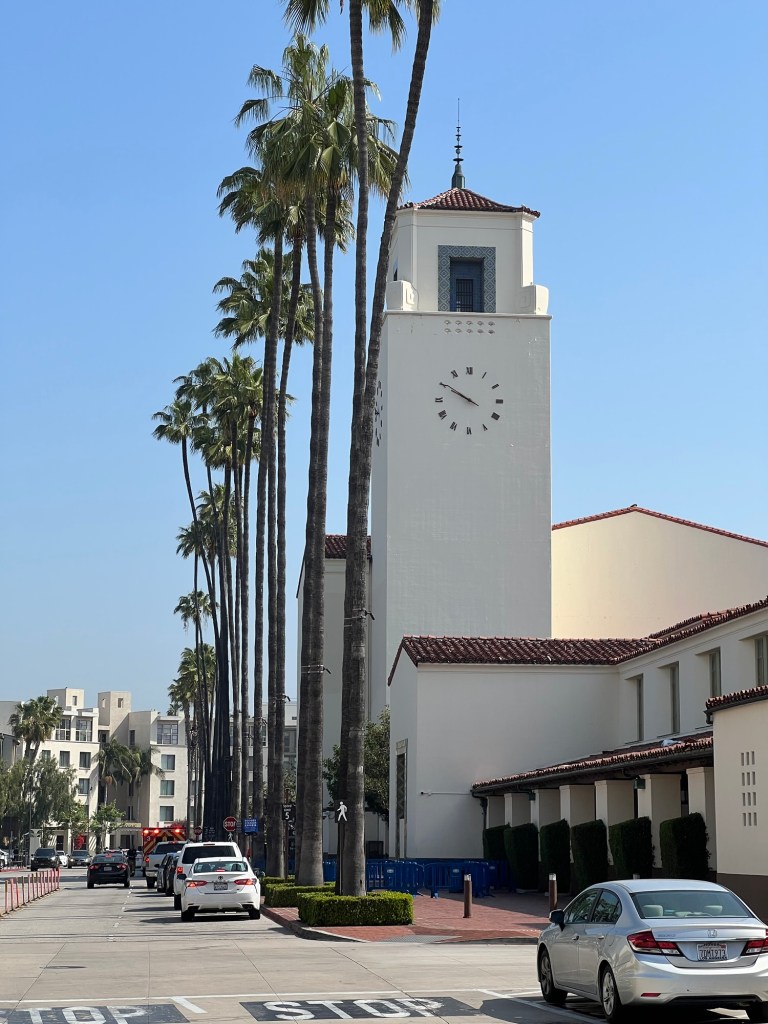
Years before Trevor and I met, he penned a Pacific Electric bookshelf track plan article that appeared in the 2003 edition of Model Railroad Planning. Trevor’s plan focused on the short-lived but operations-rich Pacific Electric express yard located in Los Angeles Union Passenger Terminal of the late 40s and early 50s, a busy, four-track express freight yard in a space about the size of a football field, framed by palm trees and stylized Spanish mission architecture. Trevor proposed to represent this tiny prototype site with a 1’ x 3’ HO layout atop a bookcase. Today we might call such a layout a ‘cameo’.
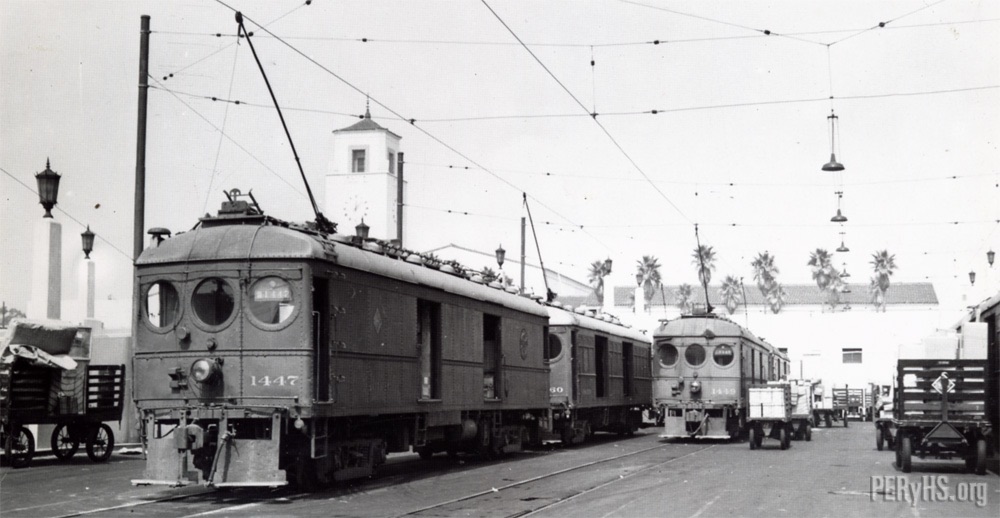
William D. Middleton Photo, Donald Duke Collection, PE Railway Historic Society web site (PERyHS.org)
Trevor’s plan and concept was simple and spurred me to learn more about the prototype Express Yard. Digging into my reference library, as well as a variety of online historical and architectural resources, I uncovered the actual size of the site, and learned that it was labeled in various maps and drawings as ‘Express Yard’.
My thoughts raced ahead to how the Express Yard might actually be built. I already had completed benchwork on hand, in the form of an unused 1’ x 4’ T-Trak module built from a CNC-cut plywood kit. DCC gear and other sundry layout construction items that were not sold with the Dunes Junction and Old Line Corridor layouts could also be pressed into service on the Express Yard.
Additionally, I already had a few pieces of PE rolling stock on hand. A business trip to Southern California even gave me a chance to explore LAUPT and the former Express Yard site, as well as check out other PE landmarks and preserved PE cars at the Southern California Rail Museum.
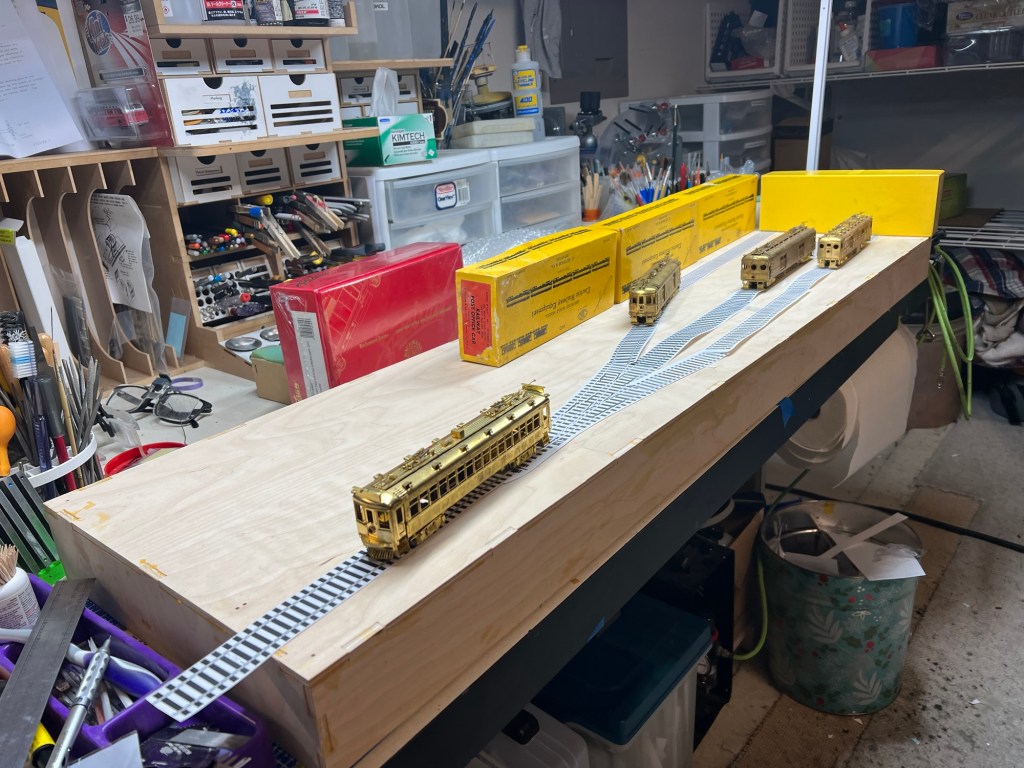
However, nearly all modeling projects benefit from testing and rehearsing critical concepts and project steps prior to fully committing—and it’s fun to test and rehearse! Using Peco’s downloadable track templates, I mocked up the track plan, used on-hand boxes to block out the major compositional lines of the Express Yard, and placed rolling stock to get a feel for what the layout could look and feel like.
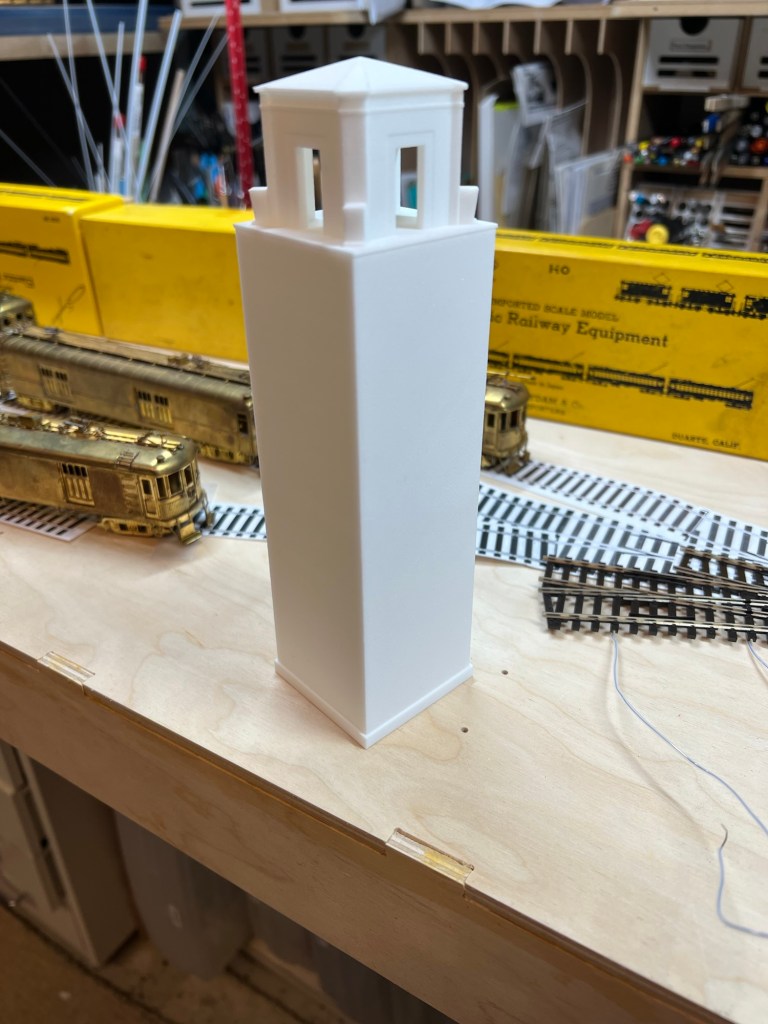
Tests and mockups certainly whet my appetite for more PE modeling and layout building, and led to more questions as to what would be needed to develop the Express Yard into a rewarding layout project.
The feature illustration of Trevor’s 2003 MRP article, and an accompanying archive photo of the prototype location provided an important hint as to what would be needed to bring the Express Yard to life: good looking and running models of PE box motors. The availability of PE rolling stock, for example, seemed at first glance to offer a significant shortcut to building a suitable roster for the Express Yard.
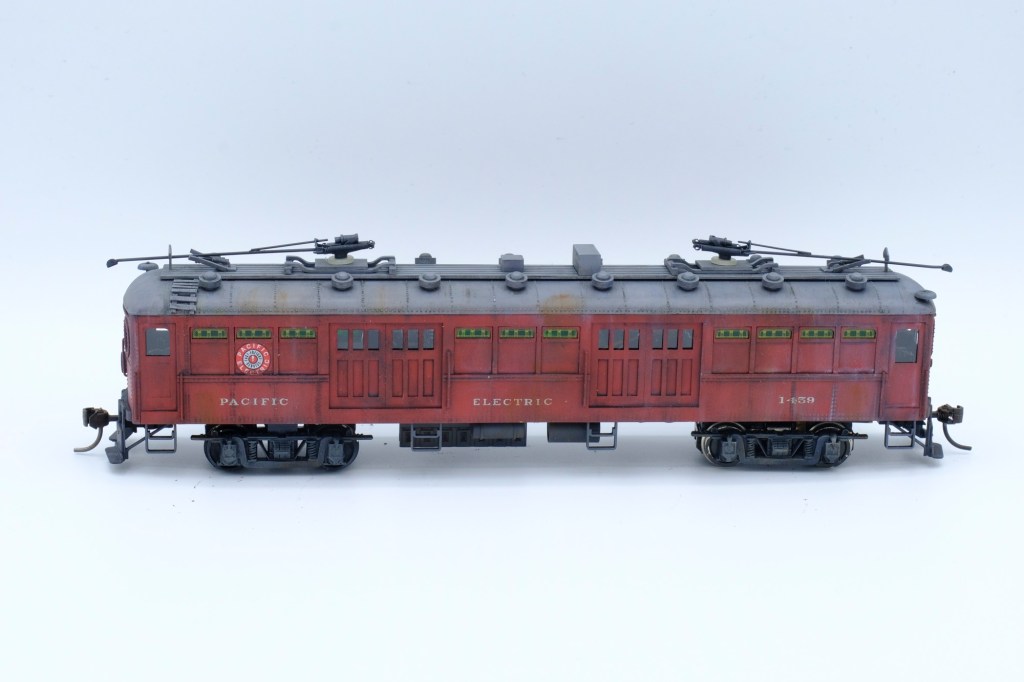
However, I knew from previous traction modeling experiences that building such an operations-ready roster would require significant effort. Fifty- to sixty-year-old brass interurban models aren’t ready for prime time. They must be remotored to run smoothly at switching speeds and accommodate DCC, and their metal construction necessitates special preparation to finish with currently available paint and supplies. To progress the Express Yard to the next stage of achievability, I would need to prove that the Suydam cars could be suitably modernized. To that end, a trial remotoring and finishing project has already demonstrated that the old Suydam cars can be brought up to 21st century standards; an upcoming post will focus on how that that test project worked out.
While a repurposed T-Trak module base will be providing most of the Express Yard benchwork, the layout will effectively be built into a box configuration with a couple additional requirements in mind. First, it will need to be a presentable display in my home office, which doubles as a guest bedroom. Second, it will need to be portable—not only in anticipation of a future relocation, but also because I would like to show the Express Yard to the world in exhibition.
To achieve these two goals, the Express Yard will be built in the cameo style espoused by Iain Rice, with the visual equivalent of a theatrical stage proscenium and lighting framing the layout. I fully expect some development friction as I engineer the cameo box for both portability and function—current thinking involves LED lighting strips and durable, lightweight materials like Gator Board or Sintra.
Another engineering and design challenge for the Express Yard will be staging and cassettes to facilitate operations. While Ian Banks’ books and other sources like UK model railway magazines provide helpful suggestions and diagrams for staging cassettes, fiddle sticks and the like, Train-Safe of Germany provides a promising one-stop staging and a display solution. A few Train-Safe components have been acquired for experimentation; regrettably, tariffs and related changes to international shipping may render Train-Safe infeasible for wider adoption for the Express Yard.
I am looking forward to finishing more PE box motors and other rolling stock, and working through the construction challenges of the Express Yard, and documenting my progress via this blog. Watch this space for updates!


 Further Up Dunes Junction
Leave a reply to Trevor Cancel reply