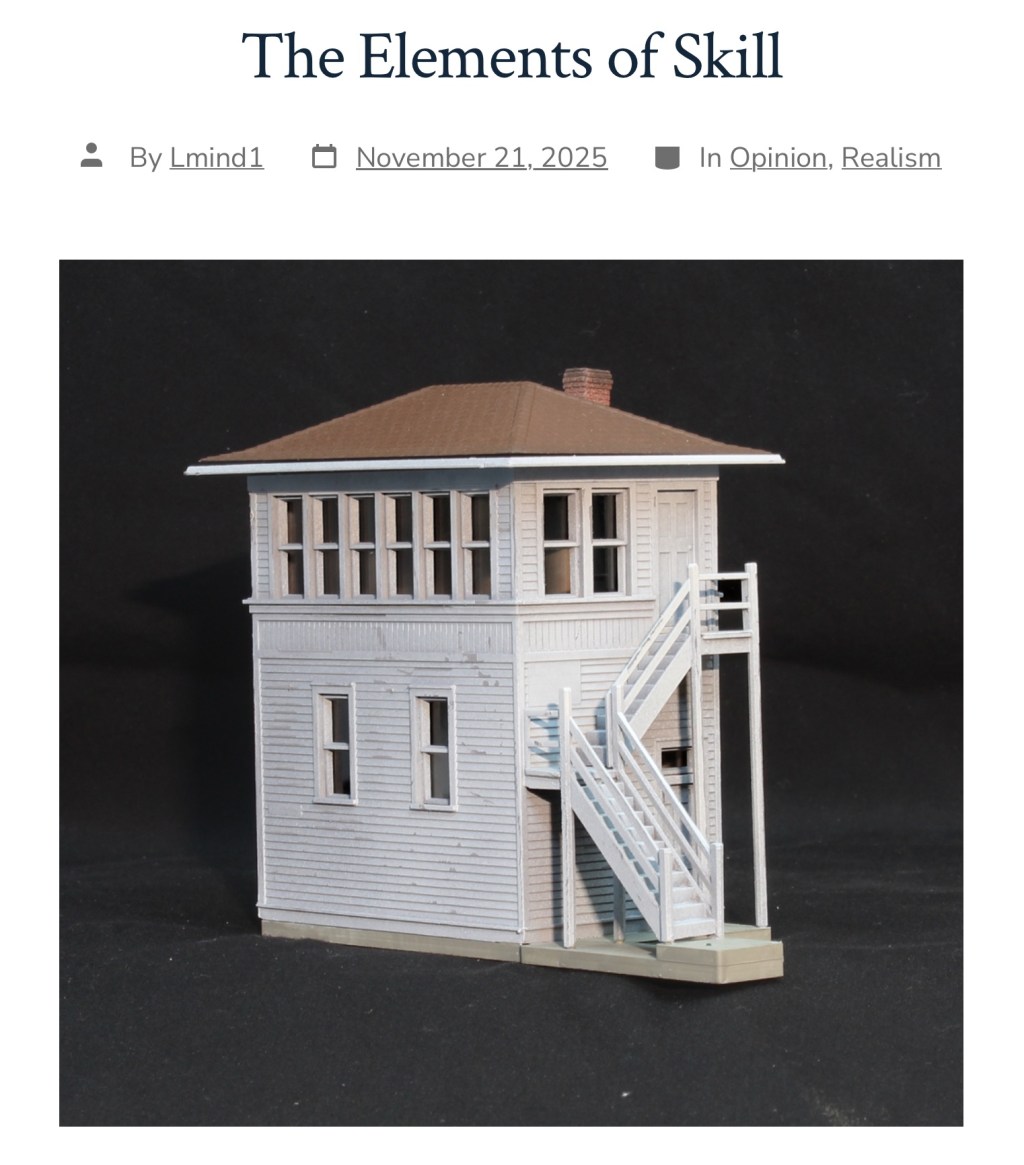
Lance Mindheim’s blog, and for that matter, his books and clinics at model railroad gatherings, are a reliable source of modeling insight and wisdom. Lance recently posted this nugget:
As much as we all strive for prototypical accuracy, the lion’s share of visual impact is delivered by composition, color strategy, and basic neatness.
Go read the post, where he makes great points about how strategy and approach (knowing what to do) counts for more than actual modeling skill and execution (knowing how to do it), and how model railroaders too often focus on technical replication of exact details and precisely matched colors at the expense of realistic coloration and composition.
Other model railroad thinkers, like Tony Koester, have similarly implored modelers to focus on reproducing the plain and ordinary instead of the oddball and memorable.
The kissing cousin of plain and ordinary colors is weathering, which is enjoying a well-deserved and extended moment in the current model railroading scene. Indeed, Lance’s evocation of ‘color strategy’ in his ‘Elements of Skill’ post implies weathering, and also color effects like fading, that might not be thought of immediately as weathering.
Such as model railroading has its own social media influencers, a significant proportion of very online model railroaders appear to be virtuosos of weathering, demonstrating techniques and/or attracting actual commissions—model railroaders sending their models out to be expertly weathered. The active supply and demand for weathering commissions seems to have inspired a few manufacturers to offer factory-weathered models, a practice already commonplace for the past few years in the UK.
However, this weathering ‘moment’ or trend in model railroading has hardly been universally embraced. When I read this bit from Lance’s post,
The culture of model railroading being what it is, many would paint [the pictured tower] a brilliant, opaque ochre with solid green trim as shown on the kit’s cover art,
I was transported back to a moment some time in the past couple of years when I sold a large lot of European prototype O scale narrow gauge equipment. The lot was a hodgepodge of rolling stock I had accumulated over time, usually second hand, some in new condition, and some that looked to be ‘senior’ or at least well-used. The buyer of the lot reached out a few days after models and money were exchanged with a consternated phone call about how at least one freight wagon had been — horrors! — weathered.
I thought I had disclosed the condition of the equipment in pre-sale dialog, and I replied that I thought it was well-executed weathering. My buyer dismissed the appropriateness of any weathering on model rolling stock, and I ended up issuing a partial refund.
The episode was a rude reminder that a not insignificant segment of the model railroading population is horrified by weathering. They’re also horrified by painting, as evidenced by the disappearance, or at least marked retreat, of three major categories of items from the mainstream hobby marketplace: paint, decals, and undecorated models.
When Floquil paint (and its sibling acrylic line, Polly S) was discontinued over ten years ago by parent company Rustoleum, the conventional wisdom was that bean-counting suits at Rustoleum didn’t value modelers or the hobby industry. But really, the model railroad marketplace had been rejecting painting (and building) for the previous decade or two, leaving Floquil, Polly S, and competitor products like Scalecoat on hobby shop shelves when modelers chose to buy the latest generation of ready-to-run locos and cars instead. Even Model Railroader magazine stopped running its monthly Paint Shop column in the early aughts, presumably in response to declining reader interest in painting and decaling.
Decals inevitably followed paint out of the mainstream model railroad marketplace. Sure, there are still a few small, short run producers of both model railroad paint and decals. However, modelers almost certainly will need to buy such products directly from their manufacturers, as many hobby retailers choose not to carry stock that doesn’t move, and when it does, in vanishingly small quantities.
Undecorated models are seemingly disappearing from the model railroading marketplace. The fine, prototype-specific models produced by Scale Trains, Rapido, Athearn, Atlas, InterMountain, and others are increasingly offered only as finished models. When undecorated models are offered, they are occasionally offered as partly undecorated, such as an unletttered switcher in a commonly applied steel industry safety yellow-and-black scheme, or rebuilt CF-7s in unlettered but in ex-Santa Fe colors. Unfortunately, such shortcuts to fun and successful protofreelancing or prototype modeling of uncommon subjects seems to be more exception than rule.
This, too, is likely a rational response to the market: if undecorated models don’t sell, it only makes sense that they’re not offered.
Implicit in Lance’s rumination on the application of modeling skill in model railroading is a challenge: do some modeling, and not just scaled-down replication. Build models well (basic neatness), finish them realistically (color strategy), and arrange them in ways that make sense in miniature (composition). Count me in for this challenge.
 Further Up Dunes Junction
Leave a comment