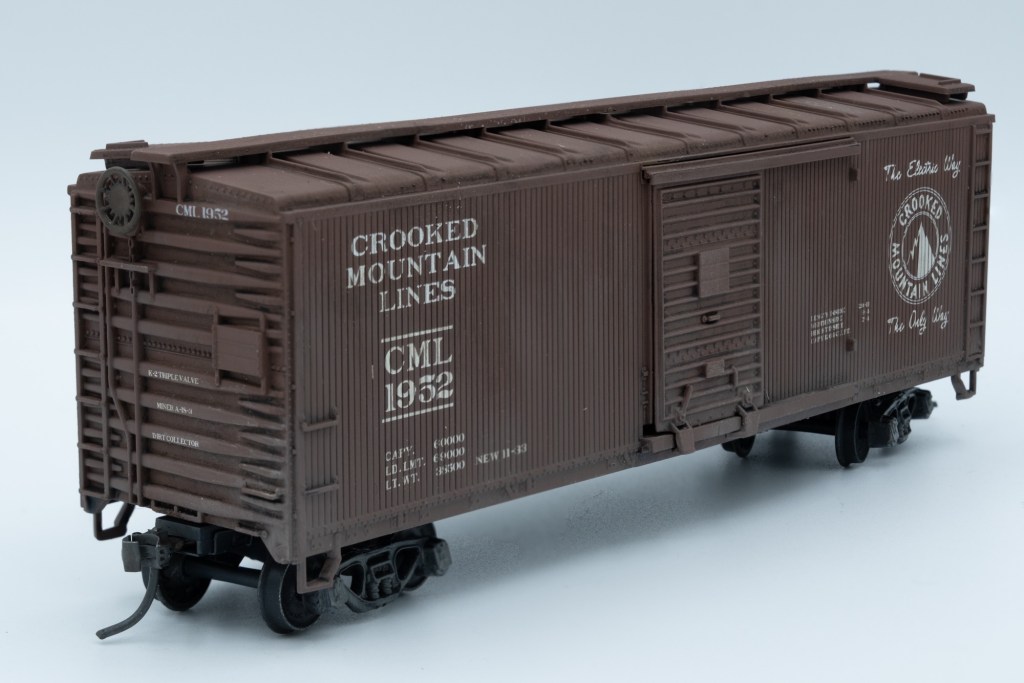
I recently came across an old treasure in my stash of model railroad supplies, this National Model Railroad Association special-run Crooked Mountain Lines heritage box car.
The Crooked Mountain Lines was the fictional home road of traction modeler Bob Hegge, who penned numerous articles in the 70s and 80s for Model Railroader and Railroad Model Craftsman magazines. (Click through here to read a short appreciation and an abbreviated bibliography) Bob photographed and penned stories about other modelers’ layouts, but his own focus was on traction modeling and his impressive O scale Crooked Mountain Lines layout. The CML was an imaginary heavy interurban in the Pacific Northwest—think Piedmont and Northern in the Cascades, or a North American version of the Swiss Rhaetian Railway. Hegge was an accomplished photographer, and his articles were typically accompanied by excellent photography optimized for the limitations of magazine production in that period.
The strong presentation of Hegge articles was a window into a well-developed protofreelanced concept backed up by excellent modeling. The other great protofreelanced model railroads of that 70s and 80s period, like Allen McClelland’s Virginian and Ohio, Tony Koester’s Allegheny Midland, and Jim Hediger’s Ohio Southern, tended to lean into organizational and operational concepts that emphasized mainline operations in HO and leveraged available cheap, reliable Athearn, Model Die Casting, and Atlas rolling stock. The V&O, AM, OS, (and others) typical of that period had protofreelance ‘legends’ or histories built from operationally reliable cars, locos, and even scenery supplies that could be had in bulk, on the cheap. McClelland even named this approach: “Good Enough.”
The CML took a different approach: Hegge’s protofreelancing backstory accommodated his lovingly scratchbuilt O scale interurban and electric models and beautifully rendered Pacific Northwest scenery, instead of endless strings of Athearn twin coal hoppers and cubic yards of lichen and puffballs. The CML’s emphasis was railroad modeling of a few pieces of rolling stock and structures, rather than big railroad organization and operating. Put another way: where Trains or Railway Age magazine might have run stories on how a real-life V&O or Allegheny Midland or Maumee stayed in business moving coal, CML would have made a great subject for treatments in the Morning Sun Books “In Color” series or by William D. Middleton centered on exciting-looking rolling stock and railroading vistas on a scrappy Pacific Northwest shoreline with catenary and pantographs.
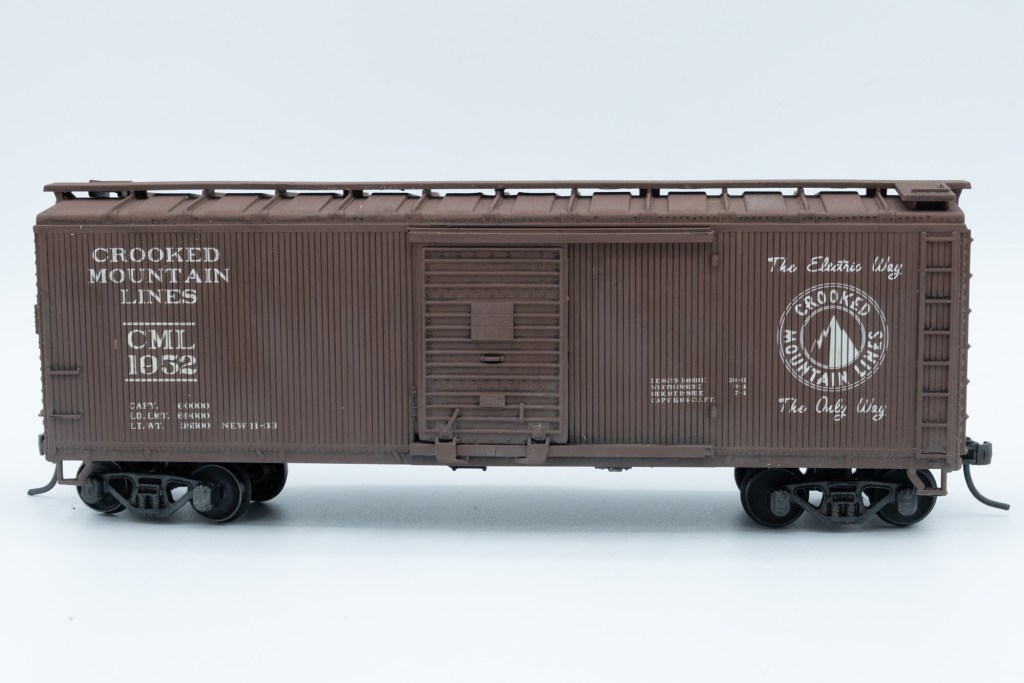
The CML worked well as its own take on what we today know as protofreelancing, as well as a touchstone of high quality traction modeling. Hegge inspired many of us who still keep faith with traction and electric subjects. His legacy is all the more impressive given that he actually published comparatively few articles and all but stopped publishing new CML material by the early 80s, yet is still called out decades later. Look around my friend Trevor Martin’s S scale Niagara Electrics layout on his blog or in his Railroad Model Craftsman articles, and mentions and glimpses of Bob Hegge and CML abound. Even today, a protofreelanced American electric railway—a 21st century take on the CML’s model-forward approach—is very much a possible future direction for my model railroading (watch this space!).
The CML box car is a special run of an old Athearn blue box kit, which assembled very quickly—conceptually, the opposite of how Bob Hegge did things.
I couldn’t help but perpetrate some modeling and finishing on this ‘collectible’ shake-the-box kit to make it into a model worthy of the CML legacy.
The floor assembly was built up and primed with Rustoleum black primer out of a rattle can. After an overnight of drying, I added the trucks, replacing the kit wheelsets with Kadee 33” rib back wheel sets, installed Kadee #58 couplers, and added a 1.5 oz of stick-on weights. The floor assembly then received an airbrushed mist of AK Real Rubber Black (a worthy successor to Floquil Grimy Black).
The sliding doors required a bit of fettling to seat squarely in their tracks on the car sides. The brake wheel was cleaned up and brush-painted with Vallejo NATO Brown, which seemed close enough to the kit’s boxcar red; once dry, it was press-fitted into place. The car body was then snapped onto the floor.
Athearn blue box detailing certainly doesn’t measure up to Tichy and particularly current resin freight car kits, but the kit’s quick assembly did allow me to quickly begin weathering, in keeping with the spirit of Bob Hegge’s characteristically well-finished models.
The first weathering step was to give the car the appropriate ‘substrate’ for my usual weathering techniques, a coat of uniform gloss. I used Alclad Aquagloss, which can be sprayed straight out of the bottle with an appropriately tipped airbrush (.5mm or greater) and pressure above 20-25 psi.
Once the gloss coat was dry, an oil wash of Burnt Umber and Turpenoid, a milder stand-in for turpentine or mineral spirits, was applied to the whole model. After drying a day or so, I then used the oil dot filtering technique to introduce some tonal variation. Traces of the artist oil filter colors—bright primaries (red, yellow, blue), and dark and light (black and and white could be used, but I prefer muted substitutes like Abt. 502 Dust and Starship Filth) remain on the model after blending to impart the fading effects of sun and precipitation damage.
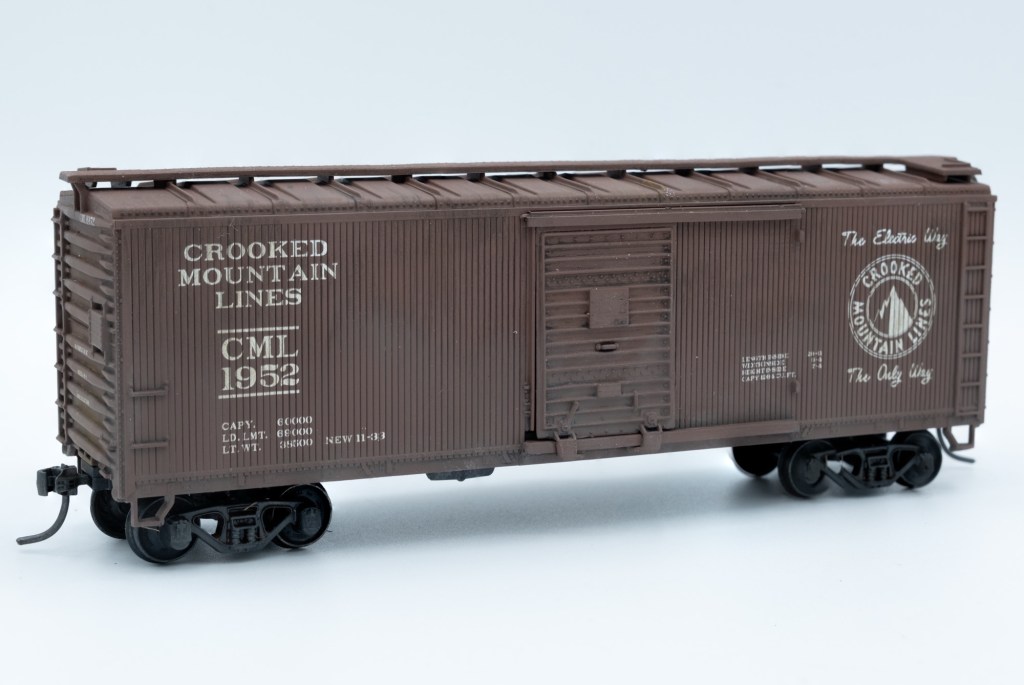
A final weathering touch is a light dry brushing of Abt. 502 Light Earth on the under frame and the lower third or quarter of the car sides and ends. A coat of VMS Matt Varnish, also sprayed straight out of the bottle at high pressure with a large-tipped airbush, sealed the weathering treatments.
I am delighted to have a small piece of CML in my rolling stock fleet. It’s easy to imagine a Pacific Electric box motor casually dragging CML 1952 into the express yard, like it belongs there. Beyond my current focus on PE, this CML kit as well as ongoing dialog with my modeling friends have stimulated my thinking about protofreelancing.
As a direct result, I am revisiting old protofreelance modeling notes from decades past…
…noticing that custom decals seem to be cheaper and easier than ever…
…and also that 20 years or so of a steady stream of HO electric prototype model releases seem to be all over eBay for cheap…
…and critically, that my modeling mojo is pretty much at its peak.
I’m excited to see how the spirit of Bob Hegge and the Crooked Mountain Lines continues to move my modeling in the months and years to come.

 Further Up Dunes Junction
Leave a comment