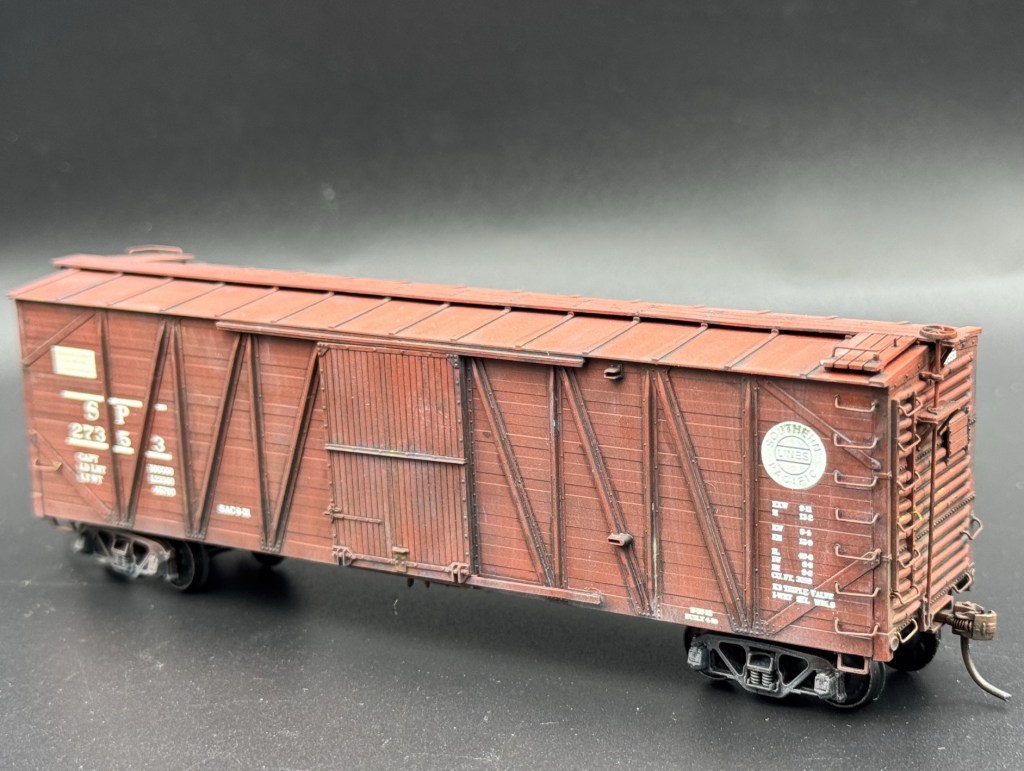
I followed up the ore cars with another Tichy offering, something a little more utilitarian and usable in a variety of operational and layout situations: a bog-standard composite (wood and steel) 40-foot box car.
The build was in some ways simpler than the ore cars, and in other ways, a little bit more complex. I wasn’t sure what to expect from this kit. I anticipated assembly somewhat akin to the ore cars, perhaps multiple flat parts for the sides, ends, and roof. However, the main box turned out to be a single, slide-molded part with a lot of — wait for it—appurtenances represented by individual parts, including wire and pre-formed wire grab irons. All of those grab iron mounting holes must be drilled out, which was tedious and a little painstaking.
Assembly is nonetheless straightforward. The instructions included in my kit were degraded by multiple generations of copying and re-copying. I found the instruction image on the Tichy web site was much clearer, and could be enlarged on my iPad or desktop computer. This was especially useful for the under frame photo that guides placement of the various air brake bits and bobs. The photo is a meaningless hash in the printed instructions, but is actually vitally helpful in the online image. I fitted Kadee #58 couplers and and 33” ribbed-back wheel sets.
I painted the 40’ box car at the same time I painted the ore cars. They were primed with Black Mr. Surfacer, followed by a marbled build up of Tamiya LP (lacquer) Hull Red to create tonal variations. Alclad Aquagloss provided a foundation for decals.
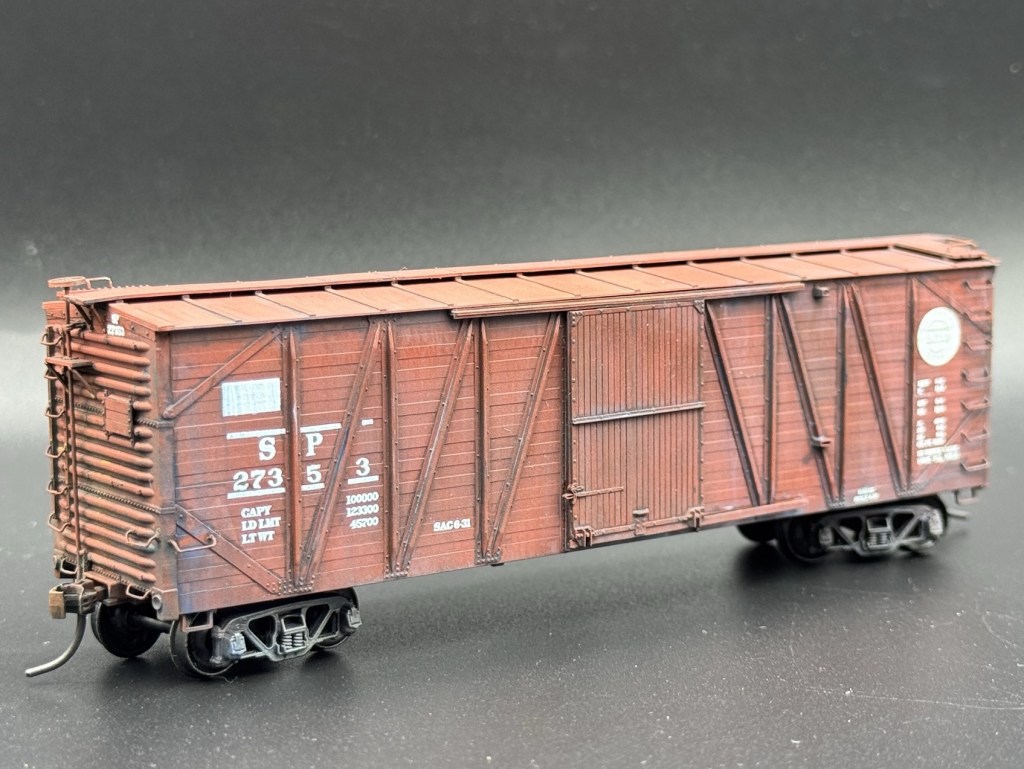
Tichy offers decals for their kits, and I chose Southern Pacific markings for this car because SP had a close relationship with Pacific Electric, which is a current modeling interest area. Tichy’s decals are mostly clear and legible, but the logos have some unflattering bleed and are not as crisp as most of the data and stenciling. The decals responded well to Micro Set and Sol.
After the decals dried, the model received another coat of Aquagloss in preparation for weathering. The model received a pin wash of dark brown AK enamel.
Once the enamel wash was dry, the car received oil dot filters to impart environmental effects like smoke and rain runoff. The bottom third or so of the car received a higher concentration of Abteilung 502 Dust and Light Earth oil dots, which were then blended together with a flat brush moistened with Turpenoid. It’s a little hair-raising to apply tiny dabs of oil paints all over a model and then blend them, which looks like a paint mess for the first few seconds of blending, but eventually looks like weathering.
The final weathering step was dry brushing of Abteilung 502 Light Earth and Dust oils on the trucks, underframe, and lower carbody. The couplers received some of this as well, along with a rusty brown mix of oils.
After the oils dried for a week or so, the completed car was clear coated with an acrylic matte varnish.
I have several more Tichy freight cars in the stash, and I look forward to building them. I’m likely to employ a few shortcuts to hasten my next build, particularly my new low-RPM precision drill press for all those grabiron mounting holes. Highly recommended for a plastic modeler who wants build a railroad model, or a model railroader who wants more than to weather a ready-to-run car.


 Further Up Dunes Junction
Leave a comment